Large parts, small tolerances
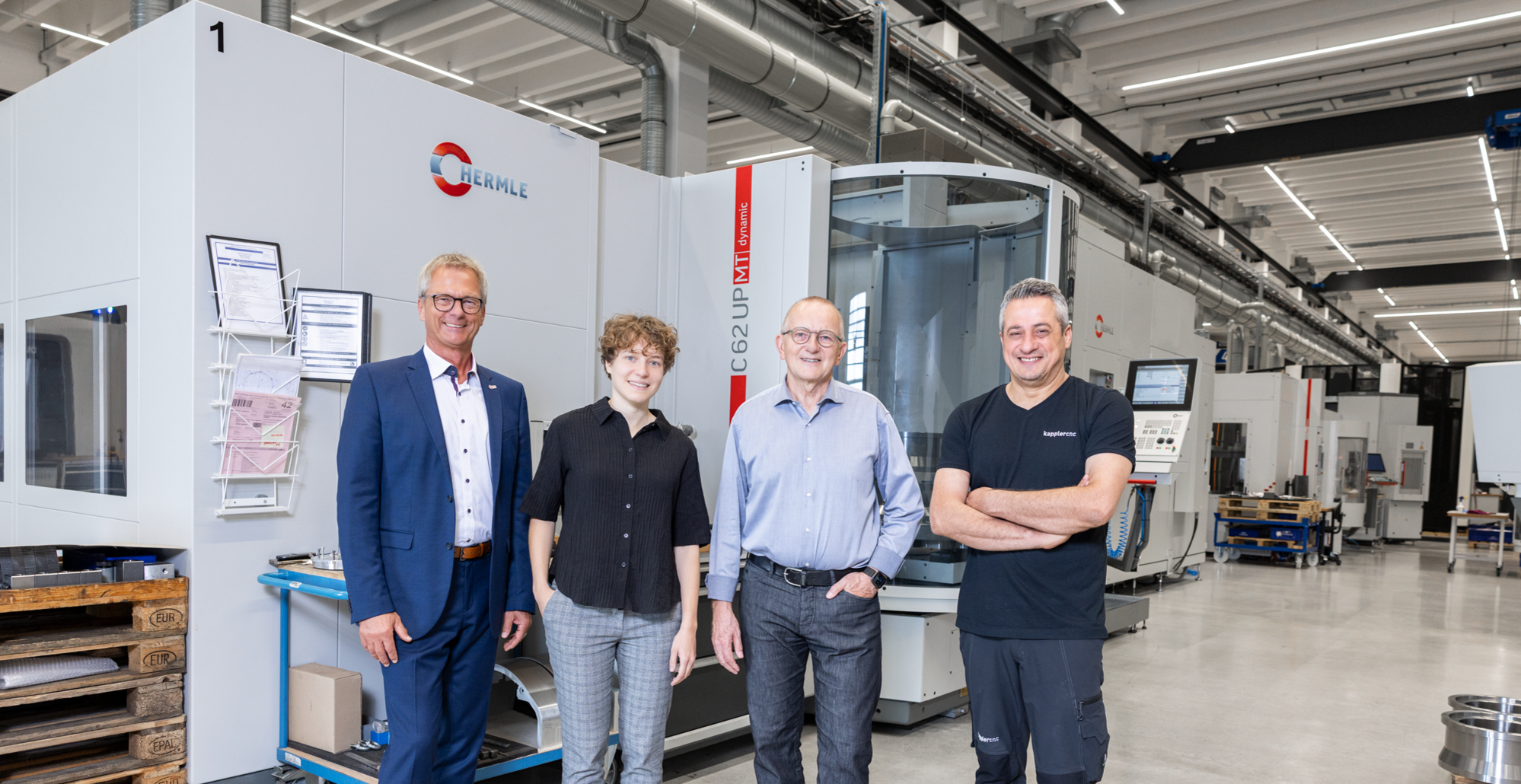
The precision manufacturer Kappler CNC has systematically increased its capacity for machining large workpieces by using three automated HERMLE 5-axis mill-turn machining centres C 62 MT. This enables the company to machine complex components precisely with minimal manpower.
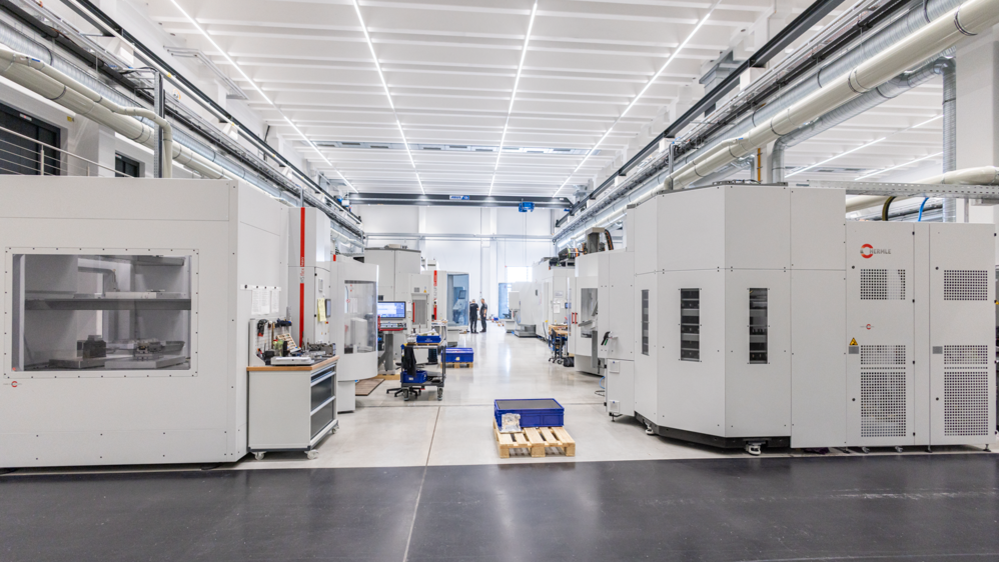
Kappler CNC's machine shops are bustling with activity but remarkably quiet, even though almost all the CNC machines are running simultaneously, machining workpieces of various shapes and sizes. The production facility in the southern German municipality of Birkenfeld is not merely an agglomeration of individual machining centres but a coordinated system. The machine shops are clearly laid out and air-conditioned. "Temperature variations cause workpieces to expand or contract, which impacts their dimensional accuracy," explains managing director Rainer Gottschling.
Vibration-damped foundations, a central extraction system and an automatically controlled machine cooling system determine the conditions on the shop floor. Among the more than 150 CNC machines are numerous HERMLE 5-axis machining centres: from the compact C 22 to the large C 62 MT. Roughly 90 per cent of the milling machines are automated, for example with the robot system RS L, which supplies three adapted C 42 machines with new workpieces.
-
Automated production at Kappler CNC generates capacity beyond two-shift operation. -
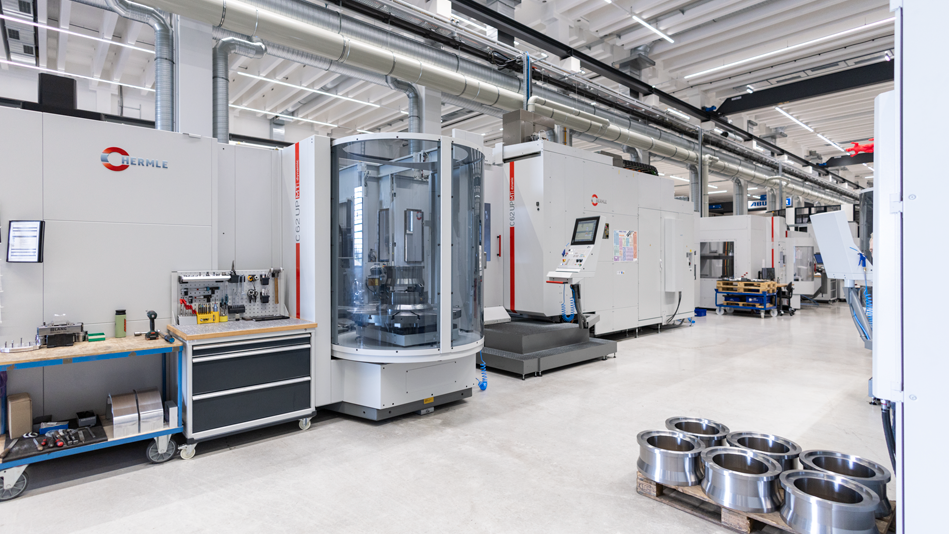
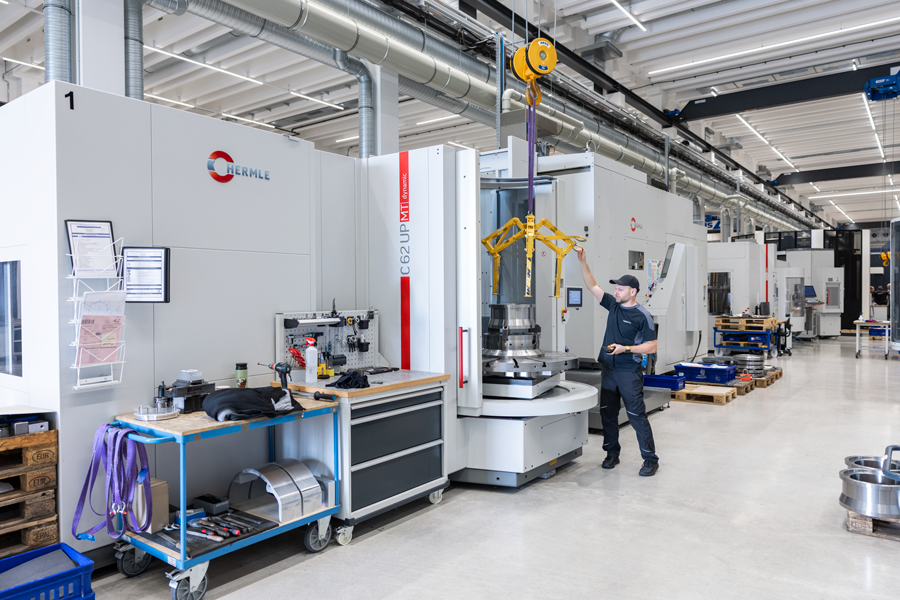
Automated turning and milling of large components weighing up to 1,500 kg: HERMLE C 62 MT with pallet changer PW 3000. -
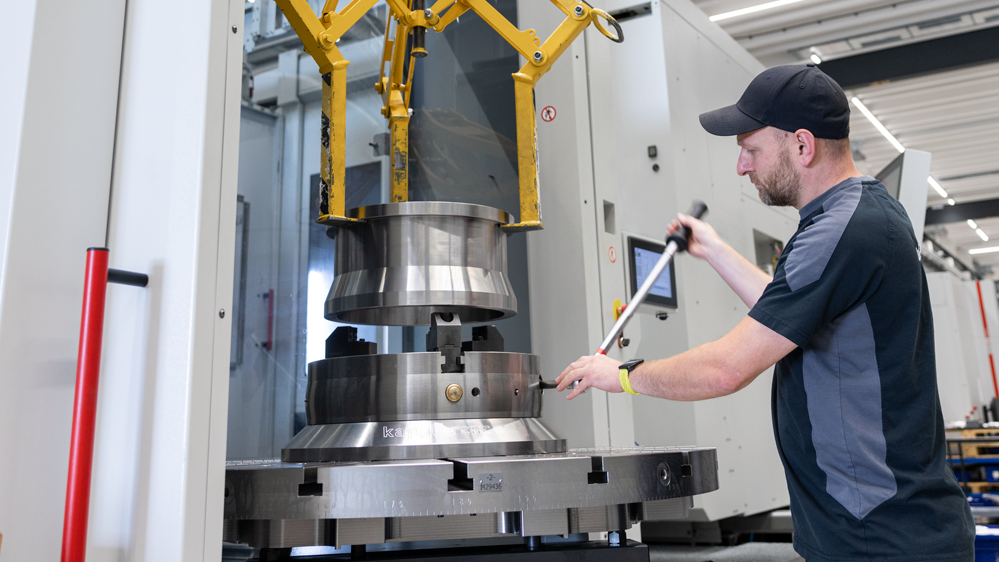
Thanks to the pallet changer PW 3000, the HERMLE C 62 MT enables main-time parallel setup. This minimises downtime and ensures long spindle runtimes. -
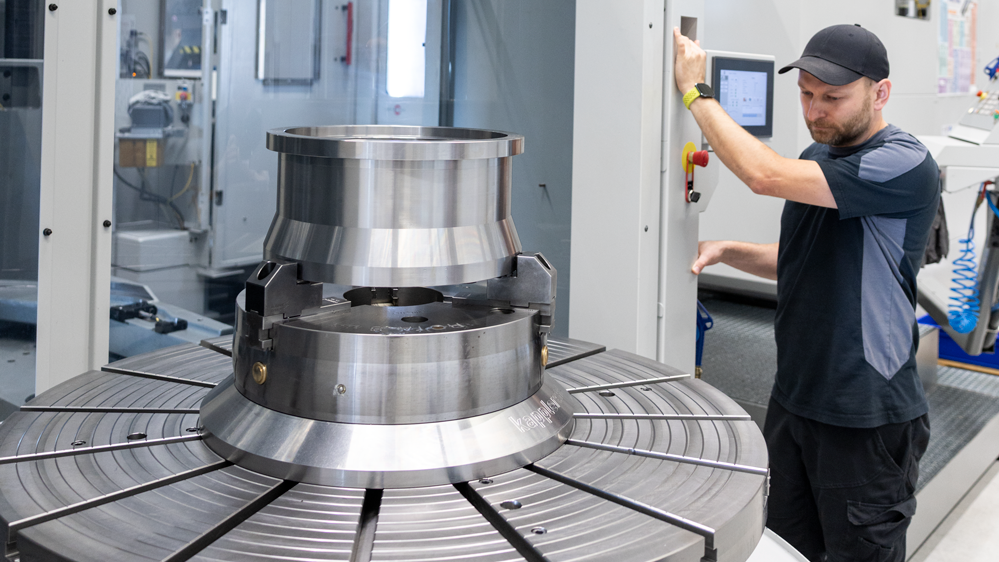
Thanks to the pallet changer PW 3000, the HERMLE C 62 MT enables main-time parallel setup. This minimises downtime and ensures long spindle runtimes. -
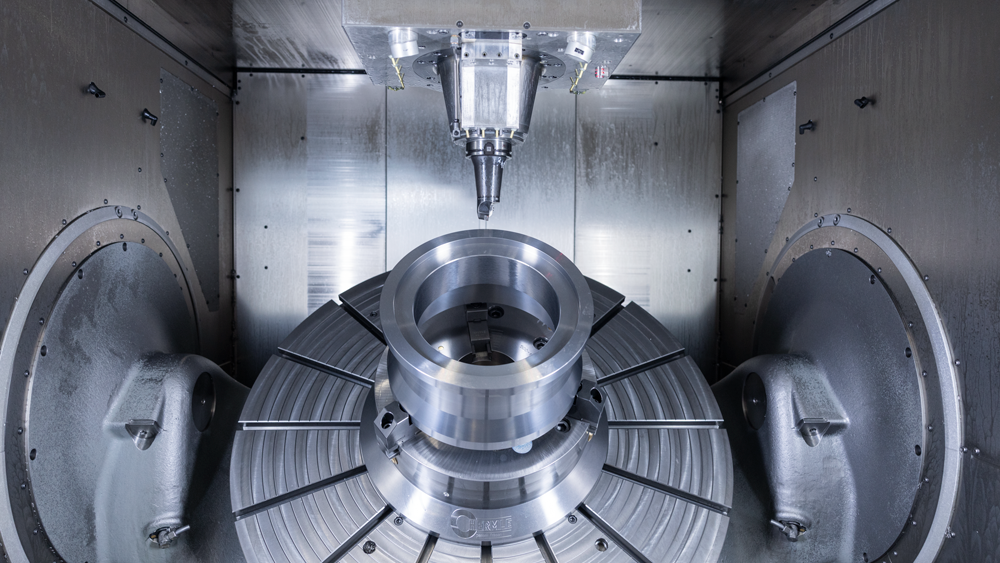
The table supports complete 5-axis milling as well as highly dynamic, simultaneous full-range turning (mill-turn technology) in the C axis.
From individual pieces to series production
Kappler GmbH & Co. KG, or Kappler CNC for short, is an owner-managed specialist for high-precision components with around 250 employees. Founded in 1934 as a family business, it manufactures components for the optical and semiconductor industries, medical technology, aerospace as well as for energy and infrastructure applications. Production ranges from prototypes to larger series. The company continues to build on its expertise and has established itself as a trusted partner for the development of comprehensive high-tech solutions. In 2020, the company relocated from Gräfenhausen to neighbouring Birkenfeld, near Pforzheim; and in 2025, it expanded its production space from 23,000 to 36,500 square metres.
The extensive range of parts places high demands on production and quality assurance. Kappler CNC machines aluminium, steel, stainless steel, non-ferrous metals and carbides, among others. There is therefore a need for machining centres that can flexibly handle not only a wide range of materials but also various geometries and machining strategies. Thirteen coordinate measuring machines are available for quality inspection. This allows the precision manufacturer to accurately inspect components measuring up to eight metres in length.
Growing and creating capacities
Between 2022 and 2024, Kappler CNC invested in three HERMLE C 62 MT machines. "We didn't just consider our current orders but also anticipated future demand," recalls Rainer Gottschling. The machining centres combine 5-axis milling with mill-turn technology, which means they can also turn workpieces weighing up to 1,500 kg. This allow the company to manufacture parts with fewer clamping setups. "Besides shortening lead times, this also reduces clamping errors," claims the managing director. The holding fixture HSK-100 creates a rigid connection between the tool and the spindle. This helps to safely transfer high cutting forces when machining large components and to limit vibrations.
At the same time, the machine remains compact: "Thanks to the swivelling rotary table, the tool is also able to reach large parts quite easily. Therefore, tools can be positioned optimally, which helps to ensure a high level of accuracy," explains Rainer Gottschling "This combination of stability and dynamic performance is crucial for us. Moreover, negative machining operations are much easier to carry out on the C 62 MT." The internal magazine accommodates up to 50 tools, and the additional magazine ZM300, which is a double tower model, offers a further 300 pockets. This means Kappler CNC can flexibly adapt to constantly changing orders.
Not every workpiece calls for the C 62 MT; but for components of certain sizes, the smaller C 52 would have soon reached its limits. And there is something else that is important to the managing director: "Having identical sister machines boosts our flexibility and enables us to respond faster. When needed, we can quickly transfer orders to the most suitable system and remain fully operational."
Automated third shift
Kappler CNC runs two-shift production. The third shift is unmanned. To achieve its goals, the company relies on automated solutions like the adapted pallet changer PW 3000. It also minimises downtime on the C 62 MT, as employees are able to prepare pallets with the machine up and running. This means the machine continues to produce while the next order is being prepared. The clearly structured HACS software (HERMLE Automation-Control-System) supports the automatic setup of various workpieces, thereby reducing setup times. Rainer Gottschling describes the user guidance of the system as a key advantage: "The software is very easy to use. This helps maintain stable operations, even during shifts with fewer qualified employees on the shop floor." Employees move between machines from different manufacturers, applying their skills wherever they are needed most for the order.
Aluminium, stainless steel, prototypes or series production: The automated C 62 MT machines adapt to the working requirements and reliably keep pace. For Rainer Gottschling, capacity utilisation is the true test of strength: "When the machines are in continuous use, you know the investment was right." And that is certainly the case at Kappler CNC. The company therefore plans to enhance its automation capabilities by introducing even more machining centres.